Category: Active Women

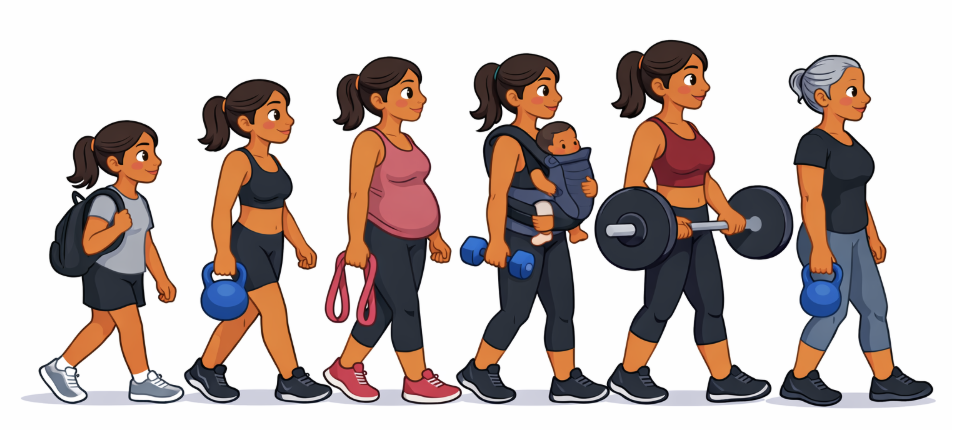
  • Training Across Life Stages: Do the Fundamentals Really Change?

    Training Across Life Stages: Do the Fundamentals Really Change?

    Women’s training advice online can sometimes make it sound as though every life stage requires an entirely new rulebook.

    Hormones fluctuate, physiology shifts and different life stages bring new considerations. But according to clinicians working closely with female athletes, the core principles of good training remain remarkably consistent.

    Strength training, cardiovascular activity, adequate recovery and proper nutrition form the foundation of long-term health and performance. These fundamentals—lifting regularly, fuelling well, prioritising sleep and reducing sedentary behaviour—continue to matter whether someone is in their twenties, postpartum or navigating perimenopause.


    When Adjustments Matter

    That doesn’t mean physiology is irrelevant. Certain life stages, particularly pregnancy and postpartum, require more individualised guidance and careful modifications.

    For some women, tracking the menstrual cycle may also provide useful insight. Hormonal fluctuations can influence energy levels, recovery and potentially injury risk. Adjusting training intensity during symptomatic phases may help some individuals train more effectively.

    However, not every woman experiences noticeable changes across the cycle. For many, rigid “cycle syncing” protocols promoted online may add unnecessary complexity rather than meaningful benefit.

    The key principle remains simple: listen to your body first, and use technology or tracking tools as supportive information—not strict instructions.


    Avoiding the Extremes

    One of the biggest challenges in women’s training advice is the tendency toward extremes.

    On one side are generic, one-size-fits-all programmes that ignore individual physiology. On the other are highly specialised protocols that portray women as fragile or dependent on complex supplements and highly specific routines.

    In reality, the most effective approach sits between the two. General lifestyle and training principles form the base, while individual symptoms and life-stage considerations guide adjustments where needed.


    Beyond Physiology: The Real Barriers

    Improving women’s long-term health through exercise is not only a physiological challenge—it is also structural.

    Dropout rates in physical activity often rise during key life transitions such as puberty, pregnancy, postpartum and menopause. Barriers range from lack of education about menstrual health to limited access to childcare, supportive facilities and knowledgeable coaching.

    Addressing these gaps may be just as important as refining training protocols themselves.


    This article summarises a recent newsletter exploring training across life stages, hormonal changes and the structural barriers that influence women’s long-term participation in physical activity.

    Read the full newsletter here

  • Listen to your body

    Listen to your body

    Feb 2025


    An interesting conversation I was having with an esteemed athlete last week brought to mind an important point


    that is well meaning but used too often by clinicians and coaches to pregnant athletes.


    ‘Listen to your body’ as a means to guiding them intuitively through how to train for their sport in pregnancy.


    Whilst well meaning, it’s not very helpful.


    What are athletes meant to be listening out for?


    The very voice (‘athlete brain’) that makes them great athletes and successful is probably not the one to listen to the most intently in this season of your life.


    Training in pregnancy is about training Smart.


    But is all pain a sign of injury and not to be pushed through?

    What’s safe?


    Can we have black and white guidelines for what you can/can’t do in pregnancy when it comes to training?

    What are the variables and what are the confounding factors?


    As an Obstetrician managing high risk pregnancies and specialising in athlete health there is very little black and white and a lot of grey.

    (This is true of Obstetrics in general to some degree).


    Each athlete will have specific risk factors in their pregnancy and each different sport


  • What Nobody Talks About in the First Trimester of Athlete Pregnancies

    Trigger warning: pregnancy loss

    Pregnancy loss is not just a taboo topic in elite sport. It is often avoided in every corner of society.

    We are told to wait until 12 weeks before sharing the news of a pregnancy — in case of miscarriage.

    Yet many women do not realise that up to 25 percent of all conceptions end in miscarriage.

    That means a significant number of women are experiencing loss, often in silence.

    Let that sink in.

    In any room of women, a quarter will have some experience with pregnancy loss.

    And elite athletes are no exception.

    What makes it even more challenging in sport is the silence.

    Many athletes have not disclosed their pregnancy — either by choice or because their sport does not require early disclosure (as combat sports might).

    Add to that the outdated, yet still lingering, misconception that miscarriage could somehow be caused by something we did or failed to do.

    As an Obstetrician and Gynaecologist working closely with elite athletes — and as someone who has personally experienced miscarriage — I want to say this clearly:

    Training does not cause miscarriage. Nothing you did caused your miscarriage.

    Still, the fear is real.

    And it is especially acute for those who have conceived through IVF.

    After investing months, sometimes years of effort, emotional resilience, financial resources, and medical support, even the most level-headed athlete may choose to be extremely cautious.

    That is completely valid.

    If we are serious about creating real, supportive fertility and preconception pathways in elite sport, we must also integrate mental health awareness and emotional support.

    Here is what performance teams need to understand:

    While there is no scientific evidence that exercise causes miscarriage, athletes may still feel the need to reduce their training load during a subsequent pregnancy.

    That is their choice. And that choice is entirely valid.

    The first trimester is short. And there is no data to suggest that lowering training intensity in response to symptoms has a negative impact on long-term performance or return to sport after birth. In fact, in many cases, it may offer benefits.

    My role during preconception and early pregnancy is to bring together medical evidence and emotional intelligence. To provide reassurance. And to say with clarity:

    Easing off in the first trimester will not derail your career.

    So here is my message — to athletes, coaches, and support teams:

    Offer grace.

    Support the whole person.

    Train with long-term intent, not short-term pressure.

    If this resonates with you, or if you are concerned or curious about how to better plan for fertility and early pregnancy in sport, I invite you to reach out. I would be glad to explore how we can work together to support your goals with the care and clarity they deserve.

  • Fail to Plan, Plan to Fail: Preconception Counselling for Elite Athletes

    One of the most powerful tools in my work as a Maternal Medicine specialist is preconception counselling.

    It is something I routinely offer to women with complex medical needs

    those with autoimmune conditions, high blood pressure, heart disease, or kidney disorders.

    But increasingly, I am offering it to a group often overlooked in this space: elite athletes.

    And I could not be more pleased that more athletes are asking for it.

    The best pregnancies are planned ones. Most people are aware of the basics like taking folic acid, vitamin D, or perhaps aspirin in certain cases

    but high-performance athletes need something more tailored.

    Their physiology, workload, and long-term goals demand a more nuanced approach.

    Elite athletes face the same fertility challenges as other women.

    Conditions like PCOS, fibroids, and endometriosis are not uncommon.

    But athletes also face unique risks.

    One of the most important is Relative Energy Deficiency in Sport (RED-S).

    It can silently disrupt the menstrual cycle, shorten the luteal phase, and even stop ovulation altogether.

    These disruptions often go unnoticed, but can lead to fertility issues or increase the risk of miscarriage.

    That is why I created the Dr Zafrani Elite Preconception Protocol — a bespoke, athlete-specific approach designed to help elite performers:

    • Optimise their health and athletic performance
    • Understand and protect their fertility
    • Make informed decisions around timing, medical risk, and career planning

    The protocol includes (but is not limited to):

    • Comprehensive hormonal and blood testing
    • Egg reserve (AMH) assessment
    • Menstrual cycle tracking and mapping for actionable insight
    • Nutrition and training reviews with performance and pregnancy in mind
    • Injury history analysis and recovery planning
    • Partner involvement, including sperm health assessments — because it is not just about the woman

    Preconception is a unique window of opportunity. What you do in this phase can shape not only your pregnancy outcomes, but your performance trajectory and long-term health.

    If you are an athlete — or support one — and want to explore how this protocol can fit into your goals, I would love to speak with you.

    Let’s make sure you are as prepared for pregnancy as you are for competition.

  • The Gynaecological Impact of RED-S: What Every Female Athlete Needs to Know

    It is encouraging to see more athletes becoming aware of RED-S.

    That awareness is vital, because no — it is not normal to lose your period just because you are training hard.

    Like many things in women’s health, we have learned to accept what is common.

    But common does not mean normal, and it certainly does not mean healthy.

    RED-S, or Relative Energy Deficiency in Sport, is now gaining attention.

    But as gynaecologists, we have recognised its effects for years.

    It was previously categorised under terms like “secondary amenorrhoea” or the “female athlete triad.”

    Often, menstrual dysfunction is only considered in the context of PCOS.

    But functional hypothalamic amenorrhoea — the result of under-fuelling and overtraining — is a serious indicator that the brain’s hormonal signalling is disrupted.

    The truth is simple.

    If you are not menstruating, it is a sign that your body does not have the energy it needs.

    And this goes far beyond fertility.

    It affects bone health, mental health, immune function, mood, recovery, and overall performance capacity.

    Yes, RED-S can affect ovulation and make it harder to conceive.

    But there are other, less talked-about consequences too:

    • Irregular or inconsistent cycles
    • Shortened luteal phase, which can increase the risk of miscarriage or failed implantation
    • Lower bone density
    • Hormonal imbalances that influence recovery, mood, and training outcomes

    When the body does not have enough energy, it goes into survival mode.

    Reproductive health becomes a lower priority — and that has lasting effects.

    In my practice, here is how I approach RED-S:

    • Taking a thorough history that goes beyond menstrual symptoms
    • Conducting a comprehensive review of training load and nutritional intake
    • Running detailed hormone profiles that look for optimal, not just average, levels

    While hormonal contraception is sometimes offered to address symptoms, I advocate for a more holistic, athlete-focused plan.

    This might include education, nutritional support, medical monitoring, and targeted strategy.

    If hormones are needed, hormone replacement therapy (HRT) is often a more suitable option.

    We cannot afford to wait until fertility is at risk to address RED-S.

    If you are concerned that RED-S could be affecting you or one of your athletes, reach out.

    I can help you navigate the gynaecological and performance implications — so health and longevity are prioritised alongside sporting goals.

  • Nutrition for Athletes in Pregnancy: (Beyond “Don’t Eat Sushi and Blue Cheese”)

    We have all heard the usual pregnancy nutrition advice:

    avoid alcohol, limit caffeine, steer clear of raw fish and blue cheese.

    But in reality, even these basics are often misunderstood by the general public.


    For athletes, the picture becomes far more complex.

    Standard advice like “you’re not eating for two” or

    “eat at maintenance until the third trimester, then add 300 calories”

    doesn’t translate well in a high-performance context.

    Most athletes do not know what their actual maintenance level is,

    especially once training volume, intensity, and energy demands are factored in.

    And for those at risk of Relative Energy Deficiency in Sport (RED-S),

    this lack of precision can become a serious concern — one I see time and again in practice.


    Pregnancy nutrition for athletes is not simply about eating enough.

    It is about adapting to a constantly shifting physiological state,

    while supporting performance, recovery, maternal health, and foetal development.

    I work closely with athletes to review their nutrition

    where appropriate — and make realistic, evidence-based adjustments.

    These plans consider everything from nausea, cravings, and food aversions to heartburn and changing energy needs.

    In some cases, especially with a history of disordered eating, tracking is not the right approach.

    That is where a clinically-informed, athlete-centred strategy becomes essential.


    By outsourcing the nutrition planning to someone who understands both obstetrics and high-performance sport,

    athletes can focus on thriving — without added mental strain or risk.

    And postnatal nutrition brings another layer.

    Metabolism changes again, and breastfeeding introduces entirely new requirements.

    (More on that in a future post.)


    If you are an athlete, coach, or member of a support team and want to understand how to optimise nutrition during pregnancy and after birth, I would love to hear from you. This is a conversation we need to be having more often.

  • The Hidden Toll of Postpartum Return in Elite Sport: What Athletes Are Really Saying

    Pregnancy and peak performance are no longer opposites.

    More elite athletes are choosing to have children and are coming back stronger

    winning medals, breaking records, and redefining what is possible.


    But behind those headlines, I keep hearing similar stories from athletes after birth:

    “It came down to luck.”

    “I had to figure it out on my own.”

    “It nearly broke me.”

    Some were lucky enough to have excellent support

    with performance teams that considered not just rehab and training,

    but also mental health, logistics, and recovery.


    Others had to carry the mental load alone,

    coordinating care, managing training, arranging childcare,

    and advocating for their own medical needs.


    Many have told me the strain was so great they considered early retirement just to start a family.

    Often, it was timing or chance

    such as the slower pace brought on by COVID or a generous coach

    that allowed them to return at all.


    But how many talented athletes are we losing

    simply because they do not have the right support system during and after pregnancy?


    There is a better way forward.


    Athletes deserve more than luck. They deserve a process.


    I work with athletes and organisations to bring clinical,

    performance-informed obstetric care into the heart of training.


    This way, pregnancy and postpartum become structured,

    supported phases — not periods of uncertainty or risk.


    Performance teams benefit from medically guided collaboration.

    Athletes receive tailored plans, clear timelines,

    and the reassurance that they are not alone in navigating this transition.


    No guesswork. No luck. Just a system that works.


    If you are an athlete,

    part of a high-performance team, or an organisation ready to build something better,

    let’s have that conversation.

  • RED-S and the Long-Term Implications on Pregnancy

    Date: July 2025

    🏃‍♀️💔 We often talk about RED-S (Relative Energy Deficiency in Sport) in terms of performance and fertility.

    But there’s something even more important to consider:

    its lasting effects on pregnancy and your baby’s health.

    When your body isn’t getting the fuel it needs, your hormones shift.

    And that delicate balance is vital for conception and carrying a healthy pregnancy.

    Without it, risks increase, like:

    • Miscarriage or preterm birth
    • Babies not growing as expected
    • Pregnancy complications like hypertension and preeclampsia

    Here’s why. RED-S doesn’t just affect your cycle. It impacts the quality of your uterine lining, how well the placenta develops, and how your blood vessels function — all of which are essential for a healthy pregnancy.

    One study published in Sports Medicine (2019) confirmed it.

    RED-S can have effects that reach far beyond the track or the field.

    That’s why we need to act early.

    Caring for RED-S isn’t just about helping athletes compete at their best.

    It’s about helping them thrive as future parents too.

    And that’s my focus.

    I work with elite female athletes to optimise their preconception health through a blend of sports medicine and personalised obstetric care.

    Together, we:

    • Detect energy deficiency before it becomes a risk
    • Restore hormonal health and metabolic function
    • Strengthen uterine and placental health
    • Build pregnancy-safe plans tailored to each athlete’s unique needs

    Because preparing for motherhood starts well before the first positive test.

    Let’s connect and create a plan to support your athletes now and their growing families in the future.